What is a restriction code (tahdit kodu)?
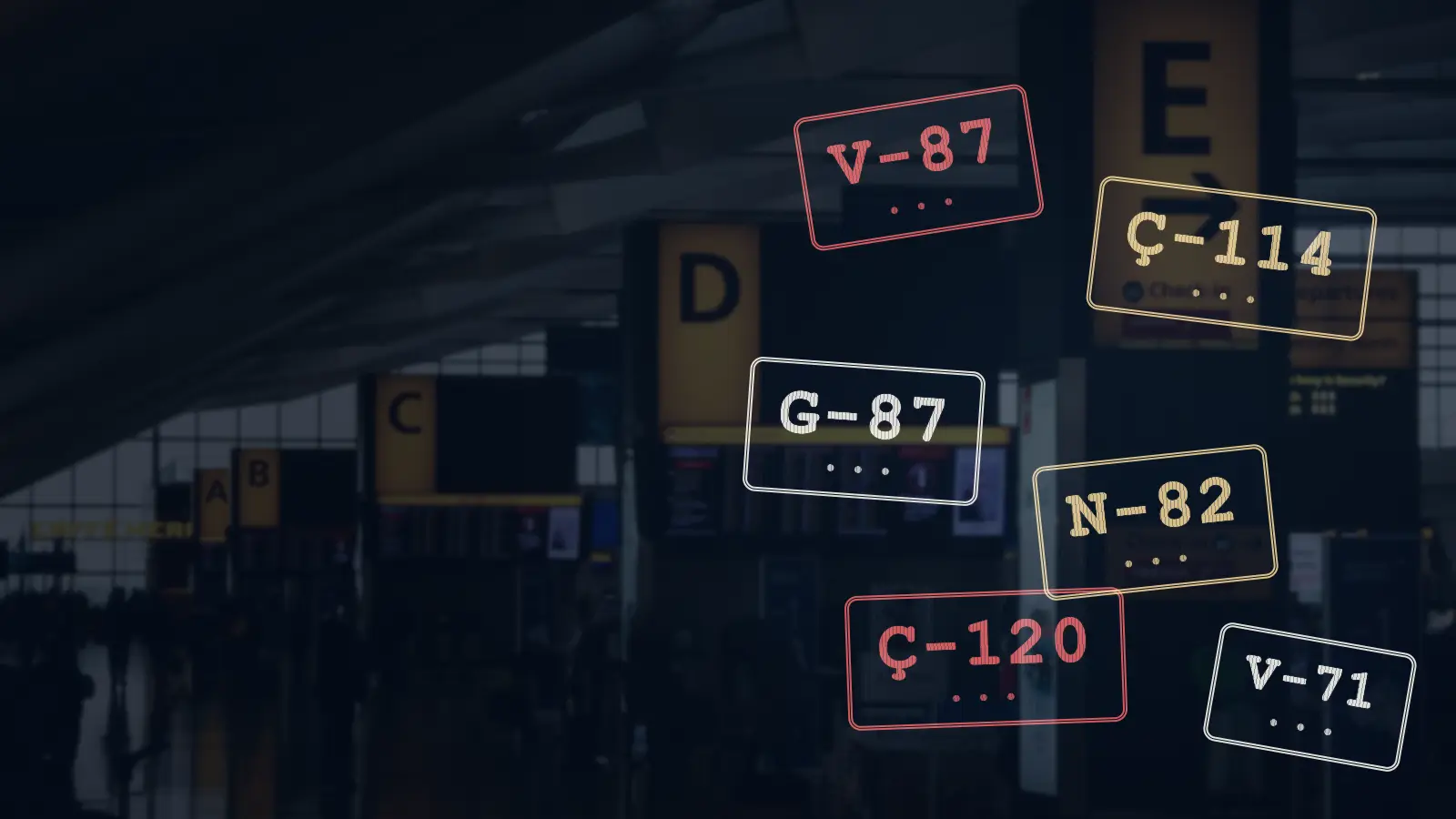
Restrictions on foreigners' entry into, exit from and residence in Türkiye are recorded in the system as codes made up of letters and numbers (e.g. V-87, Ç-114, G-87). The first letter shows the type of code: Ç mostly fixed-term entry bans, G security and crime, N prior permission, V residence and protection procedures, O international protection; while K, M and Y relate to smuggling and Interpol records.
Some codes are for information only; others result in an entry ban, a prior permission requirement or a residence restriction. Under the law, an entry ban lasts a maximum of 5 years; if there is a serious threat to public order or security, this period may be extended by a further 10 years at most.
How do I find out whether there is a code against me?
- The code is usually discovered when entry is refused at the border gate or when a deportation order is notified.
- To find out its basis, you can submit a written petition to the İl Göç İdaresi Müdürlüğü (Provincial Directorate of Migration Management) or to the Göç İdaresi Başkanlığı (Presidency of Migration Management); because the records are kept in closed systems, details may not always be given.
- The meanings of the codes are based on internal regulations that are not publicly available, and the lists on the internet differ from one another. Confirm the meaning of your own code from the notification or with the authorities.
How is a restriction code removed?
- Administrative application: First, you can apply to the authority that entered the code to have it removed. This application suspends the time limit for filing a case.
- Annulment case: A case against an entry ban can be filed with the administrative court within 60 days of notification of the decision. For codes entered by the Göç İdaresi Başkanlığı, the competent courts are usually the Ankara administrative courts. These cases can take around a year on average.
- Deportation order: The deadline for a case against a deportation order is only 7 days.
- Visa with special permission (meşruhatlı vize): Without the code being removed, it can be requested exceptionally through a Turkish consulate, with Göç İdaresi approval, for a legitimate reason such as family, education, work or health. It allows temporary entry but does not delete the code.
- Prior permission (N) codes: Most arise from unpaid administrative fines; you can pay the fine and apply to the authorities to have the code removed.
All restriction codes and their meanings
Ç — Entry ban codes
Mostly codes that ban entry to Türkiye for a set period. They are entered for reasons such as visa/residence overstays, unauthorised work, unpaid fines or security, often together with a deportation order; some are for information only.
| Code | Meaning of the code | Duration |
|---|---|---|
| Ç-101 | Visa/residence overstay – 3-month ban Entered for foreigners who exceed their visa, visa exemption, residence or work permit period by between roughly 10 days and 3 months. Entry to Türkiye is not possible for 3 months; an administrative fine is usually imposed as well. | 3 months |
| Ç-102 | Visa/residence overstay – 6-month ban Entered if the overstay lasted from 3 months (inclusive) to 6 months, and entry is banned for 6 months. If the fine was paid voluntarily at the border gate or at the provincial migration directorate, the lighter Ç-167 is applied instead. | 6 months |
| Ç-103 | Visa/residence overstay – 1-year ban Entered if the visa, residence or work permit overstay lasted from 6 months (inclusive) to 1 year. Entry to Türkiye is not possible for 1 year; if the person is still in Türkiye, they are usually deported. | 1 year |
| Ç-104 | Visa/residence overstay – 2-year ban Entered if the overstay lasted from 1 year (inclusive) to 2 years. Entry is blocked for 2 years, and it often comes together with a deportation order. | 2 years |
| Ç-105 | Visa/residence overstay – 5-year ban Entered if the visa, residence or work permit overstay lasted 2 years or longer. This is the most severe level in this group; entry is banned for 5 years. | 5 years |
| Ç-113 | Illegal entry or exit Entered for foreigners who entered or left Türkiye illegally or attempted to do so (or are suspected of this). An administrative fine is also imposed; in practice, it is one of the most common codes. | usually 2 years (according to some sources, longer if the fine is not paid) |
| Ç-114 | Subject to judicial proceedings May be entered for foreigners under investigation or prosecution over alleged involvement in a crime; their permits may be cancelled and they may be deported without waiting to establish whether they are guilty. | 1–2 years (sources give different periods) |
| Ç-115 | Released from prison Entered for foreigners who served time in prison for a crime and have been released; a deportation order is issued after release. According to sources, this code is not entered for a person who is acquitted. | 1–2 years (sources give different periods) |
| Ç-116 | Public morals / illegitimate earnings Entered for foreigners assessed as earning their living by illegitimate means or endangering public morals and public health. In practice, it is mostly linked to allegations of prostitution. | 1 year or 5 years (sources differ) |
| Ç-117 | Unauthorised (illegal) work Entered for foreigners found to be working without a work permit. The person is deported and an administrative fine is also imposed. | 1 year |
| Ç-119 | Unauthorised work fine not paid Entered for foreigners who were deported or left the country without paying the administrative fine imposed for unauthorised work. | 5 years |
| Ç-120 | Visa/residence overstay fine not paid Entered for foreigners who left or were deported without paying the administrative fine imposed for a visa or residence overstay. | 5 years |
| Ç-135 | YUKK fine not paid Entered for foreigners who do not pay administrative fines imposed under Article 102 of Law No. 6458 on Foreigners and International Protection (YUKK). | 5 years |
| Ç-136 | Deportation travel costs not paid Entered for foreigners whose travel costs were covered by the state when they were deported and who have not repaid this money. Under YUKK Art. 60, entry may be refused until the costs are paid. | until the costs are paid |
| Ç-137 | Failure to comply with an invitation to leave Entered for foreigners who were given 15–30 days to leave Türkiye voluntarily but did not leave within that period. | 5 years |
| Ç-138 | INAD (inadmissible) passenger Entered for foreigners who tried to enter Türkiye despite an entry ban and were turned away at the border gate. | up to 5 years |
| Ç-141 | International security / Ministry permission Entered for foreigners considered objectionable in terms of international security (e.g. suspected terrorist links); entry to Türkiye is made subject to the permission of the Ministry of Interior. | 5 years (entry subject to Ministry permission) |
| Ç-149 | Objectionable for public security Entered for foreigners whose entry is blocked on public security grounds; seen, for example, in cases such as travel to and from conflict zones or suspected terrorist links. | 5 years |
| Ç-150 | Attempted entry with a forged document Entered for foreigners who try to enter or leave with a forged or irregularly issued document, or with a document belonging to someone else. | 5 years |
| Ç-151 | Migrant smuggling / human trafficking Entered for foreigners linked to migrant smuggling or human trafficking offences (according to some sources a conviction is required, according to others suspicion is enough). | 5 years |
| Ç-152 | Precautionary entry block Entered for foreigners whose entry to Türkiye is blocked as a precaution, just in case. | 1 year |
| Ç-166 | No valid reason or financial means Entered for foreigners who cannot show a valid reason for coming to Türkiye or do not have sufficient financial means for the period of their stay (the conditions in YUKK Art. 15/1-f and g). | — |
| Ç-167 | 3–6 month overstay, fine paid – 1 month If the visa, residence or work permit overstay lasted between 3 and 6 months but the person voluntarily paid the fine at the border gate or at the provincial migration directorate, this lighter code is entered instead of Ç-102. | 1 month |
| Ç-179 | Organ or tissue trafficking Entered for foreigners deported for organ or tissue trafficking. | 5 years |
G — Security and crime codes
Entered for foreigners considered a risk to general security or public order, or assessed as being involved (or suspected of being involved) in a crime. They serve as the basis for deportation and entry bans; removing them usually requires a court case.
| Code | Meaning of the code | Duration |
|---|---|---|
| G-26 | Illegal organisation activity Entered for foreigners found to have taken part in the activities of an illegal organisation, or suspected of doing so; it leads to deportation and an entry ban. The authorities determine the length of the ban. | set by the authorities |
| G-34 | Document forgery Entered for foreigners found to have forged, or suspected of forging, an official or private document; it serves as the basis for deportation and an entry ban. | — |
| G-42 | Drug offences Entered for foreigners found to be, or suspected of being, involved in offences such as producing, transporting or trafficking drugs; it leads to deportation and an entry ban. | — |
| G-43 | Smuggling offences Entered for foreigners found to have committed, or suspected of committing, smuggling offences under the Turkish Penal Code; it may result in deportation and an entry ban. | — |
| G-48 | Facilitating prostitution / providing premises Entered for foreigners found to have facilitated prostitution or provided premises for it, or suspected of doing so; it leads to deportation and an entry ban. | — |
| G-58 | Homicide offences Entered for foreigners found to have committed, or suspected of committing, intentional or negligent homicide; it leads to deportation and an entry ban. | — |
| G-64 | Offence of threatening Entered for foreigners assessed as having threatened one or more people; it may serve as the basis for deportation and an entry ban. | — |
| G-65 | Theft Entered for foreigners found to have committed, or suspected of committing, theft; it may lead to deportation and an entry ban. | — |
| G-66 | Robbery (yağma) Entered for foreigners found to have committed, or suspected of committing, robbery; it leads to deportation and an entry ban. | — |
| G-67 | Fraud Entered for foreigners finally convicted of, or suspected of, fraud; it results in deportation and an entry ban. | — |
| G-78 | Carriers of a contagious disease Entered for foreigners found to be carrying a contagious disease that threatens public health; entry is blocked indefinitely. | indefinite (until it is documented that the disease is not present) |
| G-82 | Activities against national security Entered for foreigners found to have engaged in, or suspected of engaging in, activities against national security; the assessment is at the discretion of the authorities and may be based on intelligence. | — |
| G-87 | Dangerous to general security Entered for foreigners assessed as dangerous to general security, or suspected of being so; it is mostly based on intelligence and leads to deportation and an entry ban. In practice, it is the most common security code. | long-term (indefinite according to some sources) |
| G-89 | Foreign terrorist fighter Entered for people found to be, or suspected of being, foreign terrorist fighters; it leads to deportation and an entry ban. | — |
N — Prior permission (entry permission) codes
Codes that make entry to Türkiye subject to obtaining permission in advance; most arise from unpaid administrative fines or costs. Entry is not possible without permission, and in practice permission is not often granted.
| Code | Meaning of the code | Duration |
|---|---|---|
| N-67 | Wanted for fraud Entered for foreigners wanted for fraud and makes entry subject to prior permission. If the offence is international in nature, M-67 is used instead. | entry subject to prior permission |
| N-82 | Prior permission (istihzan) code Entered for foreigners whose entry is subject to prior permission; Türkiye cannot be entered without permission from Göç İdaresi. Legally it is not an entry ban, but because permission is rarely granted in practice, it works like a ban. | entry subject to prior permission (rarely granted) |
| N-95 | Fine for breaching an entry ban Entered if the administrative fine (YUKK Art. 102/1-b) imposed on a person who entered or tried to enter Türkiye despite an entry ban has not been paid; entry is made subject to prior permission. | entry subject to prior permission |
| N-96 | Fine for not leaving on time Entered if the fine (YUKK Art. 102/1-c) imposed on a foreigner who did not leave Türkiye within the 15–30 days given after a deportation order has not been paid; entry is made subject to prior permission. | entry subject to prior permission |
| N-97 | Address declaration fine Entered by the provincial migration directorate if the fine imposed on a foreigner who did not report their address correctly, did not report a change or was not found at the reported address has not been paid; entry is made subject to prior permission. | entry subject to prior permission |
| N-99 | Interpol wanted notice Entered for foreigners for whom Interpol or an Interpol member country has issued a wanted notice (e.g. a red notice). Entry is made subject to prior permission; a person in Türkiye may also be deported. | entry subject to prior permission |
| N-119 | Unauthorised work fine Entered by the provincial migration directorate for foreigners who do not pay the administrative fine imposed for unauthorised work; entry is made subject to prior permission. | entry subject to prior permission |
| N-120 | Visa/residence/work overstay fine Entered if the fee and administrative fine payable for a visa, visa exemption, residence or work permit overstay have not been paid; the code is usually entered by border gate officers. | entry subject to prior permission |
| N-135 | Illegal entry fine Shows that an administrative fine (YUKK Art. 102/1-a) was imposed on a person for entering or trying to enter Türkiye illegally; entry is made subject to prior permission. | entry subject to prior permission |
| N-136 | Deportation travel costs (notice) A notice record entered for a foreigner whose travel costs were covered by the state when they were deported. It is not a ground for deportation on its own, but the costs must be paid before entering again. | until the costs are paid |
| N-168 | Fine for absconding from detention Entered if the fine (YUKK Art. 102/1-ç) imposed on a foreigner who absconded during administrative detention, from a removal centre or during deportation procedures has not been paid; entry is made subject to prior permission. | entry subject to prior permission |
| N-169 | Non-compliance with Ministry obligations Entered for foreigners who do not pay the administrative fine imposed for failing to comply with administrative obligations set by the Ministry; entry is made subject to prior permission. | entry subject to prior permission |
| N-170 | Misdemeanours Law and other fines Entered for foreigners who do not pay an administrative fine imposed under the Misdemeanours Law (Kabahatler Kanunu) or other laws; entry is made subject to prior permission. | entry subject to prior permission |
| N-171 | Fine for non-compliance with obligations Entered for foreigners who received (and did not pay) an administrative fine for failing to fulfil certain obligations they had to comply with. | entry subject to prior permission |
| N-172 | Voluntary return travel costs Entered for foreigners who left through voluntary return while under international protection and did not pay their travel costs. | — |
V — Residence, protection and information codes
Codes showing residence permit, address, temporary/international protection and similar administrative situations. Some are for information only; others restrict the residence permit or entry.
| Code | Meaning of the code | Duration |
|---|---|---|
| V-68 | Residence permit subject to Ministry approval A foreigner with this code is not granted a residence permit unless the Ministry of Interior approves; the application follows a different procedure from the usual one. | — |
| V-69 | Residence permit cancelled Entered for foreigners whose residence permit has been cancelled (e.g. because the permit was used for a purpose other than the one it was granted for, or the documents turned out to be forged). These people are not granted a new residence permit for a period of time. | 5 years (no new residence permit is granted) |
| V-70 | Sham marriage (marriage of convenience) Entered for foreigners assessed as having entered into a sham marriage with a Turkish citizen; the residence permit is cancelled and an entry ban is imposed. Sources state that it is sometimes entered without a basis even in genuine marriages. | up to 5 years |
| V-71 | Address reporting breach / not at address Entered for foreigners who did not report a change of address, declared a false address or could not be found at their reported address; the residence application may be refused and an entry ban may follow. | — |
| V-72 | Failure to report a change of address Entered for foreigners who changed their registered address but did not report it to the migration authorities within the legal period. | — |
| V-74 | Exit subject to permission (international protection) Entered for foreigners in Türkiye with international protection status whose departure from the country is subject to permission or to notifying the Ministry/governorship. | — |
| V-77 | Application by someone who is not an Ahiska Turk Entered for people who applied for the residence or work facilities granted to Ahiska (Meskhetian) Turks but were found not to be Ahiska Turks; it prevents them from reapplying on the same grounds. | — |
| V-84 | Entry on condition of residence within 10 days Entered for foreigners who entered Türkiye on condition of obtaining a residence permit within 10 days but did not apply within that period; it leads to a fixed-term entry ban. According to some sources, this practice has been discontinued since 09.06.2020. | — |
| V-87 | Temporary protection holder who returned voluntarily Entered for people under temporary protection status (mostly Syrians) who voluntarily returned to their country. | — |
| V-88 | Work permit cancelled Entered for foreigners whose work permit has been cancelled or invalidated; depending on the reason for cancellation, an administrative fine or an entry ban may also follow. | — |
| V-89 | Covered by readmission A record entered for foreigners who entered Türkiye illegally and were accepted by another country under readmission; it is usually seen together with deportation proceedings. | — |
| V-91 | Exit subject to permission (temporary protection) Entered for foreigners under temporary protection status whose departure from Türkiye is subject to permission. | — |
| V-92 | Duplicate registration (temporary protection) Entered for foreigners with more than one temporary protection registration; the latest application is treated as valid and the earlier ones become invalid. | — |
| V-137 | Invited to leave A record entered for foreigners who have received a deportation order but were not removed immediately and were given 15–30 days to leave Türkiye voluntarily. If they do not leave within the period, an entry ban and forced deportation may follow. | — |
| V-144 | Released under Article 57-A A record entered for foreigners who cannot be deported because they would face the risk of the death penalty, torture or inhuman treatment in their country, and who stay on a humanitarian residence permit. | — |
| V-145 | Voluntary return (international protection) Entered for foreigners under international protection who voluntarily returned to their country; protection status ends with the return. For temporary protection holders, V-87 is used. | — |
| V-146 | Turkish citizen with an annotated passport An annotation added to the passport record of certain Turkish citizens who are subject to judicial proceedings; passport applications may be refused and travel abroad may be blocked. | — |
| V-147 | Spouse of an annotated Turkish citizen Entered for the spouse of a Turkish citizen whose passport carries a judicial annotation; as with V-146, passport applications may be refused. | — |
| V-148 | Staying in a temporary accommodation centre An information record entered for foreigners staying in a temporary accommodation centre. | — |
| V-153 | Constitutional Court (AYM) interim measure (third country) A protective record entered when, in an application to the Constitutional Court by a foreigner who faces a risk of death or torture if sent to their country, an interim measure is granted (safe third country situation). | — |
| V-154 | Filed a case against a deportation order An information record entered for foreigners who have filed a case with the administrative court against a deportation order; deportation is not carried out while the case is ongoing. | — |
| V-155 | ECtHR (AİHM) interim measure A record entered for foreigners in whose favour the European Court of Human Rights has issued an interim measure; deportation is halted. | — |
| V-156 | Unpaid lawyer's fees Entered if a foreigner whose case against Göç İdaresi was dismissed or lapsed has not paid the lawyer's fees (attorney's fees) they were ordered to pay. | — |
| V-157 | Residence permit application refused Entered for foreigners whose residence permit application has been refused on the grounds set out in the law. | — |
| V-158 | Diplomatic ID card cancelled Entered when the identity card of staff working at foreign diplomatic missions, or of their family members, is cancelled. | — |
| V-159 | Transit (third country) An information record entered for foreigners who will pass through Türkiye to another country; according to sources, it has no negative consequence for the person. | — |
O — International protection codes
Entered for people who withdraw their international protection (asylum) application or whose application is unsuccessful; they result in a fixed-term entry ban.
| Code | Meaning of the code | Duration |
|---|---|---|
| O-100 | Withdrew a protection application Entered for asylum seekers who voluntarily withdrew their international protection application or could not be found at the address given in the application (whereabouts unknown – semti meçhul). | 1 year |
| O-176 | Protection application unsuccessful – 3 years Entered for foreigners whose international protection application was refused, withdrawn or found inadmissible. | 3 years |
| O-177 | Protection refused / status cancelled – 5 years Entered for foreigners whose international protection application was refused or whose protection status was cancelled. | 5 years |
K — Wanted for smuggling
Used for foreigners wanted for smuggling offences. As well as blocking entry, it may also be entered to stop the person from leaving Türkiye.
| Code | Meaning of the code | Duration |
|---|---|---|
| K | Wanted for smuggling Entered for foreigners wanted for smuggling offences (with an arrest warrant against them). As well as blocking entry, it can also be used to stop a person in Türkiye from leaving the country. | — |
M — Interpol blue notice codes
Used for people for whom Interpol has issued a blue notice (to establish identity/location and gather information). Entry to Türkiye is usually made subject to the permission (prior permission) of the Ministry of Interior.
| Code | Meaning of the code | Duration |
|---|---|---|
| M-67 | Interpol – fraud Entered by Göç İdaresi for foreigners linked, according to Interpol records, to fraud of an international nature. Entry to Türkiye is made subject to prior permission from the Ministry of Interior. | entry subject to prior permission |
Y — Interpol green notice codes
Used for people for whom Interpol has issued a green notice (for warning and information purposes); according to a court decision, the purpose is to warn.
| Code | Meaning of the code | Duration |
|---|---|---|
| Y | Interpol green notice Entered for people with an Interpol green notice (for warning and information about suspected criminal activity). According to the police opinion cited in a court decision, the purpose is to warn; it is not intended to arrest the person or block their entry or exit. | — |
Frequently asked questions
What does the code V-87 mean?
V-87 is the code entered for people under temporary protection status (mostly Syrians) who voluntarily returned to their country. Re-entering Türkiye requires a separate assessment of their situation.
Is a restriction code removed automatically when its period ends?
Fixed-term codes legally expire when their period ends; however, the system record is not always updated. If there is an unpaid fine, your entry may also have been made subject to prior permission. We recommend having it checked before you travel.
Can I enter Türkiye while there is a code against me?
A visa with special permission (meşruhatlı vize) can be requested to enter without the code being removed; however, it is granted only exceptionally and is usually not possible for serious security codes. The permanent solution is an administrative application or an annulment case.
Legal basis: 6458 sayılı YUKK Art. 9, 10, 53, 54, 55; 2577 sayılı İYUK Art. 7, 11. The meanings of the codes have been compiled from explanations that appear consistently in lists published by law firms (October 2026).